
New Jersey exit tax guide
NJ Exit Tax 2026: The 2% or 10.75% Prepayment and the Refund
The New Jersey “exit tax” is not a separate tax. It is a prepayment of income tax that a nonresident seller of New Jersey real estate makes at closing: the greater of 10.75% of the gain or 2% of the sale price. On a $500,000 sale with a $40,000 gain, that is $10,000. Whatever is more than the tax actually owed comes back through Form A-3128 or the NJ-1040NR.
Quick answer
How the NJ exit tax is figured, step by step
Under N.J.S.A. 54A:8-9, a nonresident individual, estate, or trust selling New Jersey real property estimates income tax on the gain at the highest Gross Income Tax rate for the year, 10.75%, and pays at least 2% of the consideration stated in the deed. The payment travels with Form GIT/REP-1 and the deed to the county clerk. It is a credit against the seller's real New Jersey income tax for the year of the sale, not a final tax.
- Decide whether you are a resident or nonresident for the sale. The Division's FAQ treats someone who keeps a permanent home in New Jersey on or after the day of transfer as a resident. A resident signs GIT/REP-3 (box 1) and pays nothing at closing. Part-year residents are treated as nonresidents.
- Check the 16 exemption boxes on GIT/REP-3. Boxes 2 to 16 apply to residents and nonresidents, including a principal residence that qualifies under Internal Revenue Code section 121 (box 2) and a sale with no net proceeds to the seller (box 14). If one applies, GIT/REP-3 replaces the payment.
- Work out your share of the gain and of the price. Use the gain you would report for federal income tax and your percentage of ownership. “Consideration” is the full price in the deed, including any mortgage being paid off or assumed.
- Take the larger of the two figures. 10.75% of your share of the gain, or 2% of your share of the consideration. With no gain or a loss, the 2% still applies unless the Division approves a GIT/REP-4 waiver before the deed is recorded.
- Pay at closing or before it, then claim back any excess. Pay with GIT/REP-1 at closing, or prepay at a Division Regional Information Center for a sealed GIT/REP-2. After the deed is recorded, Form A-3128 or the NJ-1040NR returns what was paid beyond the tax actually owed.
Selling New Jersey property and moving away? Talk to a CPA, and check the license first.
Which form you sign, whether an exemption box fits, and how much of the prepayment comes back all depend on your residency on the closing date, your basis, and your other income. This page cannot see any of that. A CPA who prepares the NJ-1040NR or the A-3128 works from the settlement statement and your records, and New Jersey's own license record shows whether that person may practice here.
This guide explains the rules; it is not tax or legal advice. Nothing on this page is a referral or an endorsement.
What the NJ exit tax is, and what it is not
“Exit tax” is a nickname. The law behind it, N.J.S.A. 54A:8-9, was added in 2004 (P.L. 2004, c. 55) and the GIT/REP forms have been required to record a deed since August 1, 2004, according to the Division of Taxation's FAQ. GIT stands for Gross Income Tax, New Jersey's income tax, and REP for real property.
The Division says the forms exist “to determine whether a nonresident seller/grantor is required to pre-pay estimated Gross Income Tax.” A county clerk may not record the deed without the right GIT/REP form and any payment due, under TB-57(R). New Jersey residents who stay residents also file a GIT/REP form, but GIT/REP-3 box 1 lets them pay any tax on the gain later, on their resident return.
Two common errors in pages that rank for this search: the exit tax is not a realty transfer fee (the Division calls the two “separate requirements”), and the gain rate is not 8.97%. The Division's current FAQ, Form GIT/REP-1 (revision 10-21), and TB-57(R) (revised June 15, 2026) all use the highest Gross Income Tax rate, 10.75%. The 8.97% figure still appears in the Division's older “Buying or Selling a Home in New Jersey” guide (PDF last modified August 12, 2025), which may be where it comes from.
| Question | Answer | Source |
|---|---|---|
| Who pays | Nonresident individuals, estates, and trusts selling or transferring New Jersey real property, unless a GIT/REP-3 box applies | GIT/REP FAQ; TB-57(R) |
| How much | The greater of 10.75% of the seller's share of the federal gain or 2% of the seller's share of the deed consideration | N.J.S.A. 54A:8-9(a); GIT/REP-1 instructions |
| When | Before or at closing; the deed is not recorded without it | TB-57(R) |
| Is 2% a cap? | No. The FAQ says 2% “is the minimum withholding and it does not represent a cap or ceiling.” | GIT/REP FAQ |
| Corporations and LLCs | Not subject to the payment; they sign GIT/REP-3 and check box 5 | GIT/REP FAQ; TB-57(R) |
| Is it the final tax? | No. It is an estimated payment credited on the NJ-1040NR; any excess is refunded | TB-57(R); NJ-1040NR instructions, line 51 |
Exit tax vs realty transfer fee vs the over-$1 million fee
Three different charges can show up on a New Jersey seller's closing statement. Only the first is an income tax prepayment that can come back. The Division's FAQ says the realty transfer fee exemptions do not apply to the 2% nonresident withholding, and that “the RTF is separate from the Gross Income Tax.”
The fee on sales above $1 million is the one many sites call the “mansion tax.” The Division's own pages call it the Graduated Percent Fee. For deeds submitted for recording on or after July 10, 2025, when P.L. 2025, c. 69 took effect, it is graduated by price and charged to the seller instead of the buyer. The Division's own example: a $2.75 million sale owes 2.5% of $2.75 million, or $68,750, at recording.
| Charge | Who pays | How it is figured | Form at closing |
|---|---|---|---|
| Nonresident estimated income tax (the “exit tax”) | Nonresident individual, estate, or trust seller | Greater of 10.75% of the gain or 2% of the consideration; credited against income tax | GIT/REP-1 or sealed GIT/REP-2 (GIT/REP-3 or 4 when exempt or waived) |
| Realty transfer fee (RTF) | The seller, on every deed unless an exemption applies | A rate per $500 of consideration; for example $2.90 per $500 on the first $150,000 when the total is over $350,000 | RTF-1 when an exemption is claimed |
| Graduated Percent Fee, over $1 million | The seller, for deeds submitted for recording on or after July 10, 2025 | A percentage of the whole price: 1% when the price is over $1 million up to $2 million, 2% over $2 million up to $2.5 million, 2.5% up to $3 million, 3% up to $3.5 million, 3.5% above $3.5 million | RTF-1EE |
The five GIT/REP forms: which one you sign
Every seller signs one GIT/REP form for the deed to record; only sheriff's sales and bankruptcy trustee sales are excepted, per the FAQ. Each owner signs a separate form, except a married couple who will file a joint New Jersey return. Since October 1, 2025, only the current versions on the Division's website are accepted for forms signed on or after that date.

| Form | Who uses it | When and where | Payment |
|---|---|---|---|
| GIT/REP-1, Nonresident Seller's Tax Declaration (rev. 10-21) | Nonresident individual, estate, or trust with no exemption | Given to the settlement agent at closing; the county clerk sends the payment voucher to the State | Yes: check or money order to “State of New Jersey – Division of Taxation” |
| GIT/REP-2, Nonresident Seller's Tax Prepayment Receipt (rev. 10-21) | Nonresident who prepays before closing | Certified with the Division's raised seal at a Regional Information Center; the original goes to the county clerk | Yes, paid before closing |
| GIT/REP-3, Seller's Residency Certification/Exemption (rev. 8-25) | New Jersey residents (box 1), and anyone for whom one of boxes 2 to 16 applies; also corporations, partnerships and LLCs (box 5) | Given to the settlement agent at closing; not sent to the Division | No |
| GIT/REP-4, Waiver of Seller's Filing Requirement (rev. 8-25) | Sellers with no GIT/REP-3 box but a reason for a waiver, such as a sale at a capital loss | Sent to the GIT/REP Unit before the deed is recorded; TB-57(R) recommends at least 14 days before closing | No, if approved |
| GIT/REP-4A, Waiver for Corrected Deed (rev. 8-25) | The current owner correcting a typo or legal description, with no change in consideration | Filed with the corrected deed; no Division approval needed | No |
Who is exempt: the 16 boxes on GIT/REP-3
If any box applies, the seller signs GIT/REP-3 instead of paying at closing. The list below is the form's own wording, shortened. Box 1 is for New Jersey residents only; boxes 2 to 16 can be used by residents and nonresidents, including people who are not U.S. citizens, according to TB-57(R).
- Box 1: the seller is a New Jersey resident individual, estate, or trust who will file a resident return.
- Box 2: the property was used exclusively as a principal residence under Internal Revenue Code section 121.
- Box 3: a mortgagor conveying to the mortgagee in foreclosure or in lieu of foreclosure, with no added consideration.
- Box 4: the seller or buyer is a listed federal or New Jersey agency, Fannie Mae, Freddie Mac, Ginnie Mae, or a private mortgage insurer. A county or town does not count, per the FAQ.
- Box 5: the seller is not an individual, estate, or trust, such as a corporation, partnership, or LLC.
- Box 6: total consideration of $1,000 or less.
- Box 7a and 7b: gain not recognized under Internal Revenue Code section 721, 1031, or 1033, or the seller received only like-kind property.
- Box 8: an executor or administrator transferring to a devisee or heir to distribute the estate.
- Box 9: a short sale where the lender receives all proceeds.
- Box 10: a deed dated before August 1, 2004 that was never recorded.
- Box 11: a relocation-company transaction at the same price.
- Box 12: a transfer between spouses or incident to divorce under Internal Revenue Code section 1041.
- Box 13: a cemetery plot.
- Box 14: the seller receives no net proceeds on the settlement sheet.
- Box 15: a retirement trust with an IRS acknowledgment letter.
- Box 16: property bought while a New Jersey resident by a service member now deployed on active duty outside New Jersey.
The FAQ adds one point people often miss: a parent selling to a child gets no special exemption. The same boxes apply as in any other sale. For property that came to you through an estate, see the NJ inheritance tax guide for the separate waiver New Jersey real estate needs before it can pass to heirs.
Selling your home: the principal residence box
Box 2 covers a home that qualifies for the federal principal residence exclusion. The Division's “Buying or Selling a Home” guide repeats the federal tests: you owned the home and lived in it as your main home for two or more years of the five years ending on the sale date, and you did not exclude gain on another home in the two years before. The exclusion is up to $250,000 of gain, or $500,000 for a married couple filing jointly.
The Division's documents differ on one detail, so it is worth asking whoever handles the closing. The FAQ says that if the entire gain cannot be excluded, the seller does not qualify for the exemption. The GIT/REP-3 instructions (revision 8-25) and TB-57(R) say box 2 can still be checked, that tax on gain above the exclusion is paid on the NJ-1040 or NJ-1040NR, and that the seller may make an estimated payment with Form NJ-1040-ES after recording.
Moving out of New Jersey: resident or nonresident on the closing day
Whether you sign GIT/REP-3 box 1 or GIT/REP-1 turns on your residency for the sale. This page does not suggest when to move. It sets out what the Division's documents say, because they are not worded the same way.
The FAQ defines a resident as someone who “is and intends to continue to maintain a permanent place of abode” in New Jersey on or after the day of transfer, and says: “When you move out of New Jersey on or after the day of transfer, you are considered a nonresident. Part-year residents are considered nonresidents.” The “Buying or Selling a Home” guide says residents who sell and move out of the state “are considered nonresidents for the purpose of the sale.”
TB-57(R), revised June 15, 2026, describes box 1 as “based on the date of closing” and gives an example: Mary sells her New Jersey home in April, the deed is recorded in May, and because she was a resident at the time of closing, box 1 is acceptable “even though subsequent to the recording of the deed by the county the seller becomes a nonresident.” Which reading fits a given move is a question for the CPA or attorney handling the sale.

- The year you move, the Division treats you as a part-year resident. You file Form NJ-1040 for the resident period, and if you had New Jersey income after moving, such as the gain on New Jersey property sold after you left, Form NJ-1040NR as well.
- The filing threshold for that year is gross income from everywhere above $10,000 (single, or married filing separately) or $20,000 (married filing jointly, head of household, or qualifying widow(er)), per the Division's part-year resident page.
NJ exit tax worked examples, with the sums shown
These are our arithmetic from the formula in N.J.S.A. 54A:8-9 and the FAQ, shown so you can check a figure; they are not an estimate for any sale. The last column applies the tax-rate table printed on Form A-3128, which the Division uses for the refund claim; the actual tax is figured on the NJ-1040NR with all of the year's income, so the real refund can differ.
The A-3128's own example: a property sold for $315,000 with a federal adjusted basis of $279,000 has a $36,000 gain. The table rate for that gain is 3.5%, so the estimated liability is $1,260. With $6,000 paid at closing, the refund claim is $4,740.
| Situation | 10.75% of the seller's gain | 2% of the seller's price | Paid at closing | A-3128 estimate and refund claim |
|---|---|---|---|---|
| Rental sold for $600,000, $150,000 gain | $16,125 | $12,000 | $16,125 | $150,000 × 6.37% = $9,555; claim $6,570 |
| Second home sold for $500,000, $40,000 gain | $4,300 | $10,000 | $10,000 (2% minimum) | $40,000 × 3.5% = $1,400; claim $8,600 |
| Sold for $400,000 at a loss (basis $450,000) | $0 | $8,000 | $8,000, unless a GIT/REP-4 waiver is approved before recording | $0 liability; claim $8,000 |
| Married couple's main home for 10 years, $300,000 gain, moving away | Not figured | Not figured | $0: GIT/REP-3 box 2 (gain within the $500,000 exclusion) | Nothing to claim |
| One of three co-owners (25%), nonresident; $800,000 sale, $200,000 total gain | 25% of gain = $50,000; × 10.75% = $5,375 | 25% of price = $200,000; × 2% = $4,000 | $5,375 | Depends on that owner's other income |
| Installment sale: $350,000 price, $50,000 cash at closing, deed conveyed now | Depends on the gain | $7,000 on the full $350,000 | At least $7,000 | Excess can be refunded or credited forward, per the FAQ |
- Unequal ownership: each seller's form shows that seller's own percentage. A nonresident tenant in common multiplies their ownership percentage by the gain, then by 10.75%, and pays no less than 2% of their share of the consideration (FAQ).
- If a sale contract gives one seller more than their ownership share, that seller uses the amount actually received and shows the agreement to the county clerk (FAQ).
- This page has no calculator. If you were looking for an NJ exit tax calculator, the arithmetic is the two columns above: take the larger one.
Selling at a loss: the 2% still applies unless you get a waiver
The FAQ is direct: even with no gain, the seller must pay at least 2% of the total consideration on or before closing. TB-57(R) adds that a seller selling at a capital loss “must request a waiver from the Division” on Form GIT/REP-4.
The waiver request goes to the GIT/REP Unit with the original deed into the seller, the proposed deed, the settlement statement or closing disclosure, and a letter explaining the reason. If the loss comes from capital improvements, TB-57(R) asks for an itemized list with amounts. The waiver only works before the deed is recorded; after that, the only route back is a refund claim on Form A-3128 or the NJ-1040NR.
How to get the NJ exit tax back: three refund routes
The prepayment is a credit. TB-57(R) and the FAQ describe three ways to recover any part that exceeds the tax actually owed. In every case the nonresident return still has to be filed: the A-3128 says payment “does not relieve you of your responsibility to file the required return.”
| Route | When it fits | What to send | Where |
|---|---|---|---|
| Form A-3128, Claim for Refund (rev. 10-25) | After the deed is recorded and before you file the return; TB-57(R) calls it the quicker method when the sale was early in the year | The A-3128 with the settlement statement or closing disclosure; a GIT/REP-3 copy if an exemption applied but was not used | Upload at nj.gov/treasury/taxation/njonrs.shtml (Personal Income Tax, PO Box 046) or mail to Division of Taxation, Taxpayer Accounting Branch, PO Box 046, Trenton, NJ 08646-0046 |
| NJ-1040NR for the year of the sale | Any time you file the return; TB-57(R) suggests it for sales late in the year | Report the GIT/REP payment on line 51 as an estimated payment, and enclose a copy of GIT/REP-1 or GIT/REP-2 | With the return |
| Amended (or first) NJ-1040NR for an earlier year | You never claimed the refund and the year is still within the statute of limitations | An amended NJ-1040NR; the instructions say not to use NJ-1040X for a nonresident return | With the amended return |
- Due date: the NJ-1040NR instructions say the New Jersey return is generally due when the federal return is due; the 2025 return was due April 15, 2026.
- Statute of limitations: the NJ-1040NR instructions describe it as generally three years after the filing date or two years from the date the tax was paid, whichever is later.
- A New Jersey resident whose withholding was paid in error can claim it on Form A-3128, the NJ-1040, or the NJ-1040X, per TB-57(R).
- The Division must have a record of receiving the payment before it can process an A-3128, according to the form.
Estates and trusts selling New Jersey real estate
An estate or trust completes the form that matches its own residency, per the FAQ. A New Jersey resident estate or trust signs GIT/REP-3; a nonresident estate or trust signs GIT/REP-1 or GIT/REP-2 unless a box applies. Executors sign when there is a will, the administrator when there is not, and all executors or trustees may sign one form with an attachment.
Two rules are particular to estates. When an executor or administrator transfers the property to an heir to distribute the estate, box 8 applies and nothing is prepaid. When an estate or trust does pay, the gain is figured “without reduction for any distribution of income to the beneficiaries” during the year (N.J.S.A. 54A:8-9(c)). A trustee or executor who is also a beneficiary-seller signs two forms, one in each role.
Selling inherited New Jersey property usually also involves the inheritance tax waiver for the real estate. The NJ inheritance tax guide explains the classes, the 8-month deadline, and Forms 0-1 and L-9.
How to avoid the NJ exit tax: what the law already exempts
This page does not recommend a plan. Searches for avoiding the exit tax are really asking which sales are outside the prepayment, and the answer is in the GIT/REP-3 boxes and the waiver rules. Choosing among them is a decision for the seller with a licensed CPA or attorney.
- Being a New Jersey resident for the sale (box 1), read with the residency section above.
- A principal residence that qualifies under section 121 (box 2).
- A qualifying 1031 like-kind exchange (box 7a or 7b). If only part of the exchange qualifies, TB-57(R) allows 2% on the nonexempt amount at recording, or an NJ-1040-ES payment afterwards.
- No net proceeds to the seller on the settlement sheet (box 14), or a short sale (box 9).
- A sale at a loss, through a GIT/REP-4 waiver approved before recording.
- Selling through a corporation, partnership, or LLC that owns the property (box 5). Such entities do not pay the 2% withholding, per the FAQ.
Who files the NJ-1040NR, and who can help: check the license first
The seller signs the GIT/REP form and the return. A CPA can figure the gain and basis, prepare the A-3128 and the NJ-1040NR, and say which GIT/REP-3 box, if any, fits. On the A-3128, a paid preparer lists the firm name, address and federal EIN and their own Social Security number or PTIN, and a claim prepared by anyone other than the taxpayer must include an Appointment of Taxpayer Representative.
LA Trusted Professionals does not rank accountants, endorse anyone, or award a status through this page. There is no public application form on this site.
Confirm a CPA's New Jersey license, status, and any Board action with the NJ CPA license lookup guide.
How New Jersey CPA licenses are kept active is covered in the NJ CPA license renewal guide.
Wondering what preparing a return costs? The CPA cost guide sets out published fee surveys by return type.
Questions to ask before acting.
Does New Jersey have an exit tax?
Not as a separate tax. New Jersey requires nonresident individuals, estates, and trusts who sell New Jersey real property to prepay estimated income tax at closing, under N.J.S.A. 54A:8-9. It is a credit against the seller's New Jersey income tax for the year, and any excess is refunded.
How much is the exit tax in NJ?
The greater of 10.75% of the seller's share of the federal gain or 2% of the seller's share of the price in the deed. On a $500,000 sale with a $40,000 gain, 10.75% is $4,300 and 2% is $10,000, so $10,000 is paid at closing. The 2% is a minimum, not a cap.
Who needs to pay the NJ exit tax?
Nonresident individuals, estates, and trusts selling or transferring New Jersey real property, unless one of the seller's assurances on Form GIT/REP-3 applies. New Jersey residents, and corporations, partnerships, and LLCs, sign GIT/REP-3 and do not prepay.
Is the NJ exit tax 8.97% or 10.75%?
10.75%, the highest Gross Income Tax rate. The Division's FAQ (updated September 28, 2026), Form GIT/REP-1, and TB-57(R) (revised June 15, 2026) all use it. Some pages, and the Division's older Buying or Selling a Home guide, still show 8.97%.
How do I get my NJ exit tax back?
After the deed is recorded, file Form A-3128 with the settlement statement to the Division's Taxpayer Accounting Branch, PO Box 046, Trenton, NJ 08646-0046, or upload it online. Or report the payment on line 51 of the NJ-1040NR for the year of the sale. A forgotten refund can be claimed on an amended NJ-1040NR within the statute of limitations.
Do I pay the NJ exit tax if I sell at a loss?
Yes, 2% of the consideration, unless the Division approves a GIT/REP-4 waiver before the deed is recorded. TB-57(R) says a seller at a capital loss must request the waiver and recommends sending it at least 14 days before closing. Otherwise the 2% can be claimed back on Form A-3128 or the NJ-1040NR.
Does the exit tax apply when I sell my primary residence and move out of New Jersey?
If the home qualifies for the federal section 121 exclusion (owned and lived in for two of the last five years; up to $250,000 of gain, or $500,000 for a married couple filing jointly), GIT/REP-3 box 2 applies and nothing is prepaid. The Division's documents differ on what happens when the gain exceeds the exclusion; see the principal residence section above.
Is the exit tax the same as the realty transfer fee or the mansion tax?
No. The Division calls the GIT/REP withholding and the realty transfer fee “two separate requirements.” The fee on sales above $1 million, often called the mansion tax, is the Graduated Percent Fee: 1% to 3.5% of the total price, charged to the seller for deeds submitted for recording on or after July 10, 2025. Neither fee is an income tax prepayment.
What form do I need to sell a house in New Jersey?
One GIT/REP form per seller: GIT/REP-1 (nonresident paying at closing), GIT/REP-2 (nonresident who prepaid at a Regional Information Center), GIT/REP-3 (resident or exempt), GIT/REP-4 (approved waiver), or GIT/REP-4A (corrected deed). The seller also files the RTF-1 when claiming a realty transfer fee exemption.
Does an estate selling inherited property pay the NJ exit tax?
A New Jersey resident estate signs GIT/REP-3 and does not prepay. A nonresident estate prepays on GIT/REP-1 or GIT/REP-2 unless a box applies, and figures the gain without reducing it for distributions to beneficiaries. An executor transferring the property to an heir under the will uses box 8.
Original and attributed sources
Return to the record behind each claim.
A link shows where a fact came from; it does not turn every statement on that source into an independently verified claim.
- NJ Division of Taxation — FAQs on GIT/REP forms for the sale or transfer of real propertyThe 10.75% / 2% formula, residency, forms by seller type, estates and trusts, consideration, waivers, refunds, and the RTF being separate. Page last updated September 28, 2026; read October 21, 2026.
- NJ Division of Taxation — Technical Bulletin TB-57(R), Estimated Gross Income Tax Payment Requirements on Sales of New Jersey Real Property by Nonresidents (PDF)The five forms, key GIT/REP-3 boxes with the box 1 closing-date example, capital-loss waivers, the 14-day recommendation, and refund timing. Revised June 15, 2026; read October 21, 2026.
- N.J.S.A. 54A:8-9 — Payment of estimated tax by nonresident taxpayer on certain gainsHighest rate times the federal gain, 2% minimum of the deed consideration, property partly outside New Jersey, and estates and trusts. Statute text as compiled by Justia (2025); read October 21, 2026.
- NJ Division of Taxation — Form GIT/REP-1, Nonresident Seller's Tax Declaration (PDF)The 10.75% rate, the 2% minimum, the estate and trust rule, and where the payment goes. Revision 10-21; read October 21, 2026.
- NJ Division of Taxation — Form GIT/REP-2, Nonresident Seller's Tax Prepayment Receipt (PDF)Prepayment before closing, certified at a Regional Information Center. Revision 10-21; read October 21, 2026.
- NJ Division of Taxation — Form GIT/REP-3, Seller's Residency Certification/Exemption (PDF)The 16 seller's assurances, the definition of consideration, and the box 2 instructions. Revision 8-25; read October 21, 2026.
- NJ Division of Taxation — Form GIT/REP-4, Waiver of Seller's Filing Requirement (PDF)Waiver requests sent to the Division before recording. Revision 8-25; read October 21, 2026.
- NJ Division of Taxation — Form GIT/REP-4A, Waiver for Corrected Deed (PDF)Corrective deeds with no change in consideration. Revision 8-25; read October 21, 2026.
- NJ Division of Taxation — Form A-3128, Claim for Refund of the Estimated Gross Income Tax Payment for the Sale of New Jersey Real Estate (PDF)The tax-rate table, the $315,000 worked example, required attachments, the online upload route, and the PO Box 046 address. Revision 10-25; read October 21, 2026.
- NJ Division of Taxation — 2025 Form NJ-1040NR Instructions (PDF)Due date, line 51 for real property estimated payments with a GIT/REP-1 or GIT/REP-2 copy, amended nonresident returns, and the statute of limitations. Read October 21, 2026.
- NJ Division of Taxation — Estimated Gross Income Tax Payment Requirement for Nonresident Sellers of Real PropertyN.J.S.A. 54A:8-8 through 8-10 and the GIT/REP-3 and GIT/REP-4 exemptions and waivers. Page last updated September 28, 2026; read October 21, 2026.
- NJ Division of Taxation — Part-Year ResidentsFiling both NJ-1040 and NJ-1040NR in the year of a move, and the $10,000 / $20,000 filing thresholds. Page last updated September 28, 2026; read October 21, 2026.
- NJ Division of Taxation — Buying or Selling a Home in New Jersey (PDF)Residents who sell and move away, the federal principal residence tests and limits, and the early A-3128 refund. This guide still shows 8.97%; PDF last modified August 12, 2025; read October 21, 2026.
- NJ Division of Taxation — Realty Transfer FeeRTF rates per $500 and the Graduated Percent Fee on transfers over $1 million, charged to the seller. Page last updated September 28, 2026; read October 21, 2026.
- NJ Division of Taxation — Memorandum: Amendments to Graduated Percent Fee on Realty Transfers over $1 Million (PDF)P.L. 2025, c. 69, effective July 10, 2025: graduated rates, the fee moved to the seller, and the $2.75 million example. Dated July 2, 2025; read October 21, 2026.
- Wikimedia Commons — New Providence, NJ house in wintertimePhoto by Tomwsulcer, taken March 7, 2014, released under the CC0 1.0 public domain dedication. Resized and used as this page's photo.
- Pexels — A Person Giving a Bundle of Keys to another Person, by Alena DarmelForms-section photo, used under the Pexels License (free to use and modify; attribution not required).
- Pexels — Empty apartment with packed carton boxes before moving, by Ketut SubiyantoMoving-section photo, used under the Pexels License.
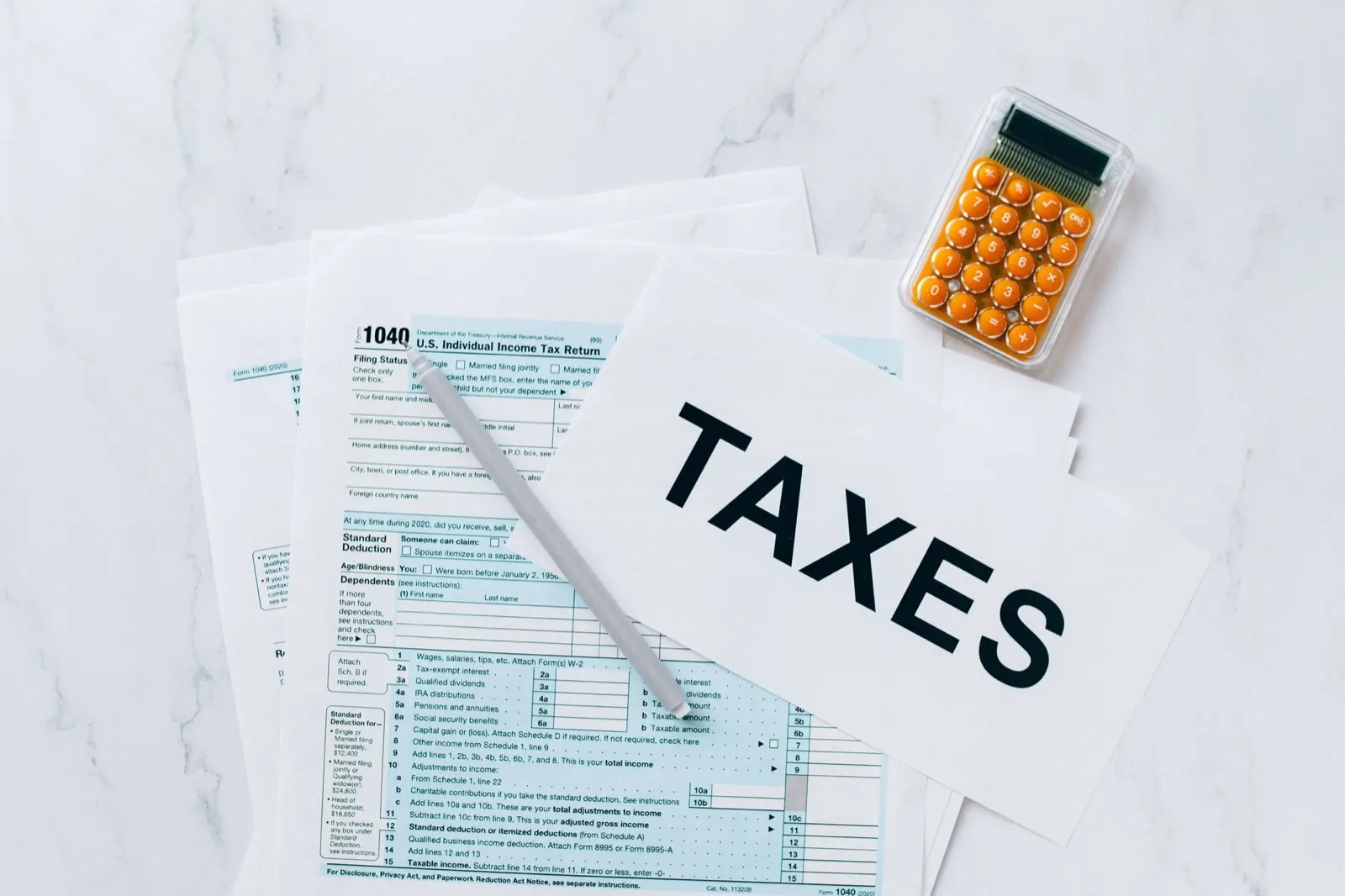
- Pexels — Tax Documents on the Table, by Nataliya VaitkevichRefund-section photo, used under the Pexels License.